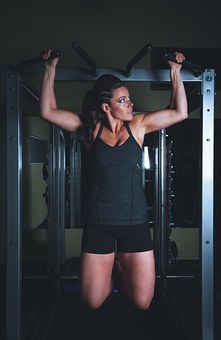
Alright so this particular workout we will talk about today is the “pull up” and the different combinations of pull ups, and what it takes in order to do a pull up, because it is a bit more than what meets the eye. In today’s fitness world, being able to do a pull up without assistance is a huge milestone and one that many people want to show off (instagram, facebook, youtube, at the gym, etc). This particular exercise isn’t easy and it takes patience and practice like any other exercise but it also takes building the right muscles in order to lift your body weight. I was one that didn’t know how to do a pull up; about 8 months ago and for me it was my lack of strength and not working on the muscles needed in order to do one. Today I am totally capable of doing a pull-up, but for those of you who do them on a more regular basis, you are capable of doing many more than I and with attached weight plates (advanced). I highly recommend for beginners that you don’t go adding unnecessary weight to this already difficult exercise and that you focus on the movement at hand. There are many variations of pull-ups and many ways that you can challenge yourself in order to increase your skill level. For those of you who may already know how to perform a proper pull up, you may offer more advice to those who want to learn, and feel free to do so in my comment section.
The traditional pull-up movement steps:
- Grab the pull bar with palms facing forward (wide grip, close grip, medium grip) for this one be in your medium grip (hands spaced out at shoulder width apart)
- With both hands extended in front of you at a chosen grip, bring your torso back around 30 degrees,
- Pull your torso up until the bar touches your upper chest while drawing the shoulders and upper arms down and back. Only the arms should move and the back should stay stationary, you will be exhaling during this movement
- after a second of being in the contracted position, start to inhale and slowly lower your torso back to the starting position when arms are full extended and the lats are fully stretched.
- Repeat this movement for the prescribed repetitions.
- Timed hangs, I would recommend to hang for 10 to 15 seconds with arms and legs straight (off the ground) for a repeated amount of times.
- Dumbbell holds (for beginners), I would recommend holding dumbbells for 30 seconds at your side, if you come to realize you cannot hold the amount of weight for 30 seconds, then decrease your load and rest for 60 seconds and repeat the hold
- Planks (because it is a total body exercise and helps with stabilization) not to mention you are holding your own body weight.
- Push ups-Once again you are working with your own body weight and helps strengthen the chest, shoulders and arms.
- Weighted pull up
- Muscle ups
- Around the world pull ups
- Clapping pull ups – yes people do these on youtube, and it is very cool, but again.. no one needs to go to these extremes in order to make a point.
- One arm pull up
- Parallel pull up
- Cliffhanger pull ups
- Towel pull ups
- Wide grip pull up
- chin up/ underhand pull up
- Kipping pull up
- Close grip pull up
- pull up with alternating knee twist
- pull up with leg raise
- Multi-joint exercise
- convenient
- different variations
- improves grip strength
- strengthens the lats, back, biceps, shoulders, and the abdominal area.
 Be the best version of you
Pull-ups are an unmatched movement! Great article.
LikeLiked by 1 person
Thank you! I will agree with you on that one.
LikeLiked by 1 person